 Call: (724) 912-8151


-
Family-Owned
Locally and family-owned in Hopwood, serving Fayette County and surrounding areas.
-
Free Estimates
Licensed & insured, PA203391. Call (724) 912-8151 for a free estimate.
 Family-Owned
 Free Estimates
Mold Removal & Prevention
Mold grows on wood, drywall paper, carpet and dust wherever moisture stays long enough, and in a basement or a crawl space that can be most of the year. KAE Solutions removes and treats mold in basements, crawl spaces and sheds for homes in Hopwood and across Fayette County. The mold is only half the job, though. If the water that feeds it isn't stopped, cleaned surfaces grow it again. So every mold job we do starts with one question: where is the moisture coming from? Inspections and estimates are free: call (724) 912-8151.
Mold Removal in Fayette County, PA
Mold needs three things: moisture, something to feed on, and time. Fayette County supplies plenty of the first. NOAA's 1991-2020 normals for the Uniontown 1 NE station count 44.35 inches of precipitation a year, against 39.61 at Pittsburgh's airport, spread over 161.2 days with a hundredth of an inch or more. A basement here rarely gets a long dry spell between rains, and a basement that stays damp from the spring thaw into summer gives mold months to spread.
The ground keeps that water close. The USDA soil survey for Fayette County lists ground water near the surface ("depth to saturated zone") as a limitation for houses with basements on 49.1% of the county's soil acres. Around a foundation in that soil, water presses against the walls for weeks after a storm. Older block, stone and brick foundations let some of it through. Block walls weep at the mortar joints and at cold joints, where one pour of concrete meets another, and old stone walls were laid with no waterproofing at all. Many of these basements were never meant to be living space. Once carpet, paneling, drywall and stored boxes go in, the moisture finds plenty for mold to feed on.
Signs of Mold in a Basement or Crawl Space
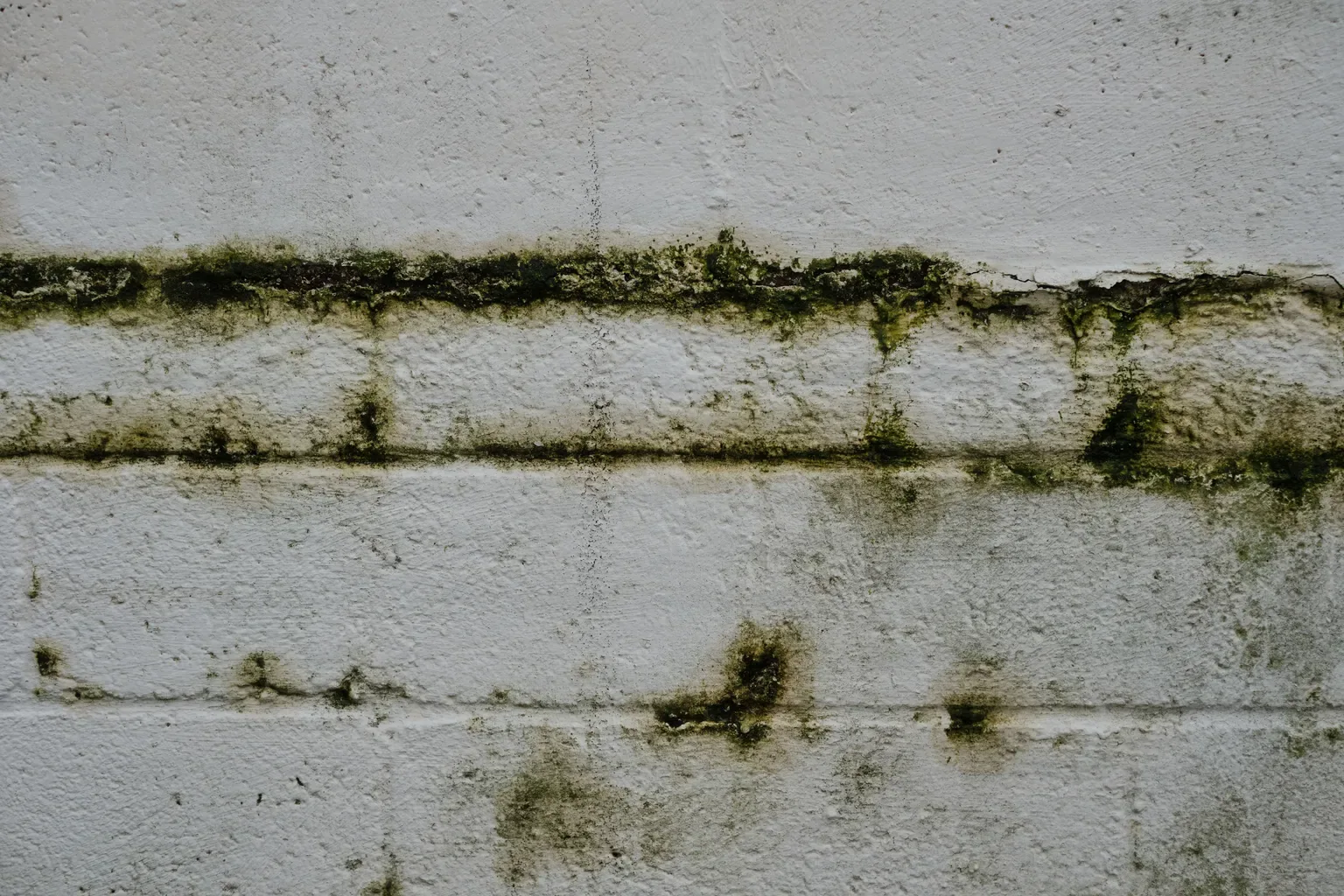
Mold isn't always out in the open. It grows behind paneling, under carpet and on the hidden side of drywall, and you often smell it before you see it. These are the signs to look for:
- A musty smell that comes back every time after you air the basement out.
- Spots or fuzzy growth on joists, drywall, paneling, stored boxes or the back of carpet.
- Stains and peeling paint on the walls, often in a line near the floor.
- Damp walls or floors, or condensation dripping off cold water pipes in summer.
- High humidity that running a fan doesn't change.
- Soft, dark wood on sill plates, joists and stair stringers.
- Recent water: a leak, a failed sump pump or a storm that put water on the floor.
That last one matters even when the floor looks dry again. Our post before the October 2026 storms said it: "If you've already had water in your basement or crawlspace, don't forget about the mold that can come along with it." Drywall, carpet pad and cardboard soak water up and stay wet inside long after the surface dries, and growth can start on them within a day or two.
How We Remove Mold, Step by Step
We explain each step before we take it, so you know what is happening in your home and why. A typical job goes like this:
- Find the moisture. We trace where the water comes from: a foundation crack, a weeping wall, a gutter emptying at the foundation, a dead sump pump, a damp crawl space or humid air.
- See how far it goes. We check the extent of the growth, including behind paneling, under carpet and up into the crawl space framing.
- Remove what can't be cleaned. Porous materials that have grown mold, like drywall, ceiling tile, carpet and pad, usually have to come out. Hard surfaces such as concrete, block and sound framing lumber can be cleaned.
- Clean and treat. We clean the affected surfaces and apply a professional mold treatment spray. In a crawl space that means the joists, the subfloor and the sills.
- Dry it out. Treated wood and walls have to dry, or the growth comes back.
- Prevent. A preventative spray and the moisture fix help keep the space from sliding back to where it was.
Sheds and outbuildings that have leaked get the same treatment as basements and crawl spaces. One review of a mold removal job in a home describes it like this:
“Anthony is very knowledgeable on the services he is providing. He performed mold removal in our home and was very responsive, professional, and explained in thorough detail every step he was taking to remedy the situation.”
Olivia C., Google review
Mold Remediation vs Mold Removal: What the Words Mean
People use the two words for the same job, but they mean slightly different things. Mold removal is what it sounds like: taking out and cleaning off the growth you can see. Mold remediation means fixing the whole situation: removing the growth, treating the surfaces and correcting the moisture that let it grow, so the space goes back to a normal condition. Mold spores are in outdoor air and indoor air everywhere, so no one can make a house free of every spore. What can be done is to remove the growth and take away the moisture it needs, and that is the job we do.
Honest, straightforward advice. No pressure, no scare tactics. We show you what we see, tell you what it will take, and let you decide. Sometimes the answer is small: a patch of mildew on a joist next to a loose dryer vent needs cleaning, a treatment and the vent put back together. Sometimes it's a basement wall with water coming through it, and then the waterproofing is the real job and the mold is the symptom.
Stopping the Moisture Behind the Mold
We'll identify the source and recommend a lasting solution, not a temporary patch. For mold, the fix is usually one of these:
- Basement walls that leak or weep: interior or exterior basement waterproofing, with drains and a sump pump.
- A damp crawl space: crawl space encapsulation, with a sealed vapor barrier and moisture control.
- Roof water at the foundation: gutter lines, downspout extensions and grading that carry the water away from the walls.
- Condensation: warm, humid summer air meeting cold block walls and cold water pipes. Insulating the pipes, sealing the openings that let outside air in and keeping the space drier stop the dripping that feeds mold on the walls and the floor below.
- Water damage already done: wet materials out, the structure dried and repaired, as our basement restoration page explains.
Mold removal without the moisture fix is the temporary patch, and we'd rather do the job once. We remove and treat mold in homes and commercial buildings from Hopwood to Connellsville and across Fayette County. Call (724) 912-8151 and tell us what you're seeing or smelling, and where.
Seeing or Smelling Mold?
Call (724) 912-8151 for a free estimate.
Questions We Hear a Lot

-
We find the moisture source first, then check how far the growth goes. Moldy porous materials like drywall and carpet usually come out, hard surfaces are cleaned, and we apply a professional mold treatment spray. Then the moisture gets fixed, because mold on a surface that stays wet tends to grow back.
-
Mold remediation means removing mold growth and correcting the moisture that caused it, so the space returns to a normal condition. Mold removal often means only the cleanup. Spores are in all air, indoors and out, so the goal is no active growth and no moisture to feed it, not a spore-free house.
-
Because the moisture is still there. A leaking wall, a gutter emptying at the foundation, a failed sump pump or damp air will grow mold again on surfaces that were cleaned. We look for that source on every job and tell you what it would take to stop it.
-
Yes. Our mold treatment and preventative spray work covers basements, crawl spaces and outbuildings such as sheds. In a crawl space the joists, subfloor and sills get treated, and we look at the vapor barrier and moisture control at the same visit.
-
Yes. Inspections and estimates are free. Call (724) 912-8151 or use the contact form, and we'll come look at the problem and tell you what we'd do.
-
Yes. KAE Solutions is a Pennsylvania registered home improvement contractor, PA203391.
-
We're based in Hopwood, PA, and serve Fayette County and the surrounding areas of Southwestern Pennsylvania, including Uniontown, Connellsville and Mount Pleasant. Call (724) 912-8151 to check your location.
-
- Service Area Fayette County, PA &
surrounding areas - Working Hours Open 24 hours7 days a week
-


