 Call: (724) 912-8151



-
Family-Owned
Locally and family-owned in Hopwood, serving Fayette County and surrounding areas.
-
Free Estimates
Licensed & insured, PA203391. Call (724) 912-8151 for a free estimate.
 Family-Owned
 Free Estimates
Foundation Repair & Bowing Walls
A basement wall that bows, leans or cracks sideways is holding back more than it was built for. KAE Solutions repairs and reinforces foundation walls for homes across Fayette County and Southwestern Pennsylvania from our base in Hopwood, most often with carbon fiber wall straps bonded to the inside of the wall. A strong home starts with a solid foundation. The inspection is free: call (724) 912-8151 and tell us what you've noticed.
Signs Your Basement Wall Is Bowing
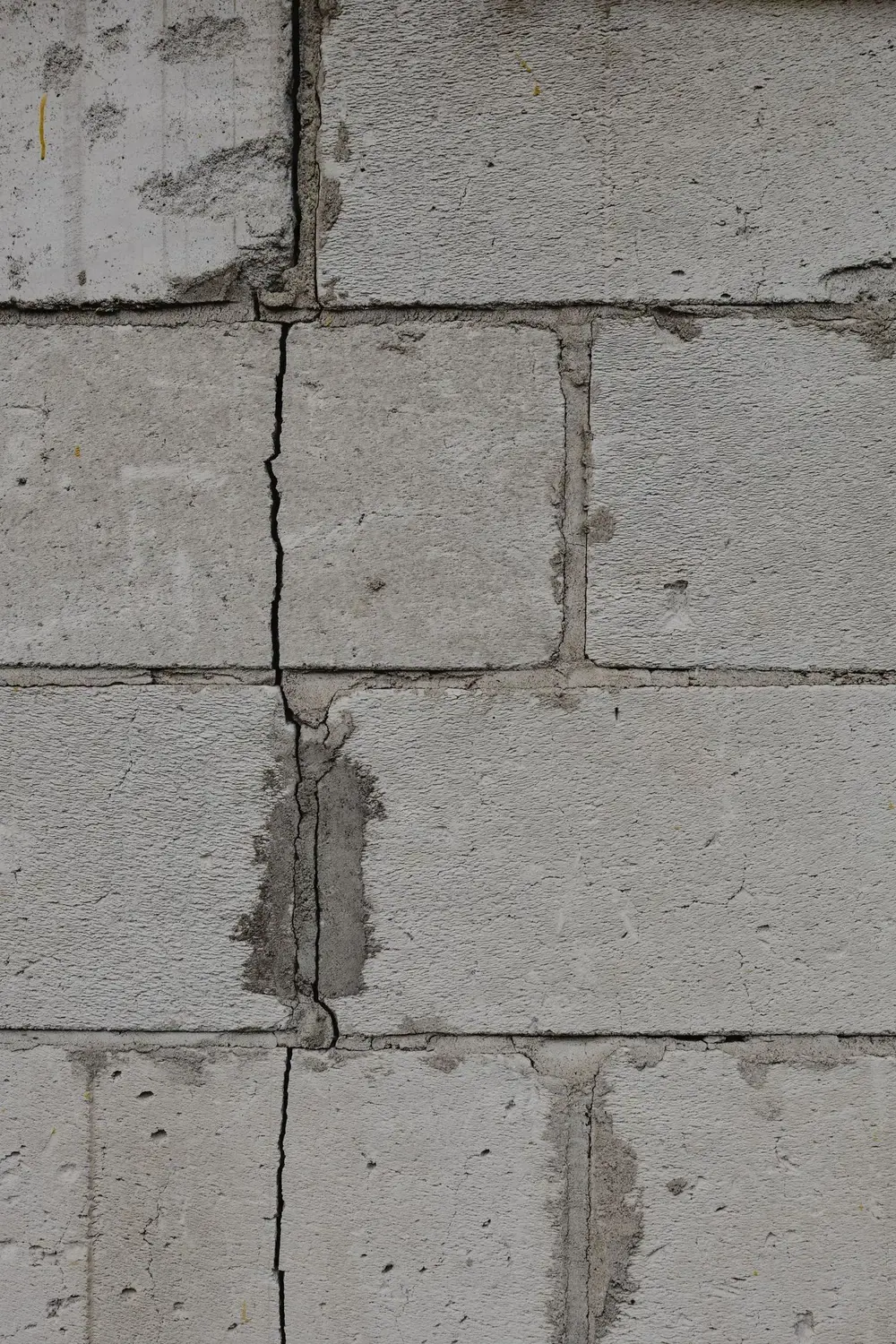
Bowing rarely shows up all at once. It starts as a crack and a slight lean that's easy to live with for years. These are the signs we look for on an inspection:
- A horizontal crack running along a block wall, often near the middle of its height or a few courses below the top, where the wall is bending inward.
- Stair-step cracks climbing through the mortar joints of a block wall, usually from a corner.
- A wall that leans in at the top, or one whose bottom has slid in past the top.
- Gaps at the top of the wall where it meets the sill plate and floor joists, or blocks that have shifted out of line.
- Water and white powder along the crack. A crack that weeps after rain, or leaves a white mineral crust behind, is letting water through the wall as well.
Bowing walls don't fix themselves; they usually get worse over time. A simple way to know whether yours is still moving: mark the ends of the crack with a pencil and the date, measure how far the wall leans at its worst point, and check again after the next wet season. A single vertical hairline crack in a poured wall is a different problem, and our foundation crack repair page covers those.
What Pushes Foundation Walls In Around Fayette County
A basement wall is a retaining wall with a house on top. On the outside, several feet of soil press against it, and that pressure goes up when the soil is full of water. As Anthony put it in one of our posts: "Weather shifts, saturated soil, and freeze/thaw cycles can put major pressure on your foundation walls." Fayette County has all three.
- Wet ground. The USDA soil survey rates 88.6% of Fayette County's soil acres "Very limited" for dwellings with basements. On 42.6% of acres the water table comes within 2 ft of the surface at some point in the year. Soil that stays wet against a wall is heavier, and water standing in it presses on the wall on top of the soil's own weight.
- Clay that swells. Shrink-swell is a limitation on 21.3% of the county's acres. Clay soils expand when they get wet and pull back when they dry, so the wall takes a fresh push every wet spell.
- Rain and frost. NOAA's 1991-2020 normals for the Uniontown 1 NE station come to 44.35 inches of precipitation a year and about 103 days that freeze and thaw. Wet soil that freezes against a wall expands, and frost pushes on the upper few feet of the wall, the part closest to the surface.
Older houses take it hardest. Many homes here were built in the 1940s or earlier, on block or stone walls with no drain at the footing and no waterproofing on the outside. Those walls were built to hold up a house, not to hold back saturated clay for more than eighty years.
Carbon Fiber Wall Straps: How They Are Installed
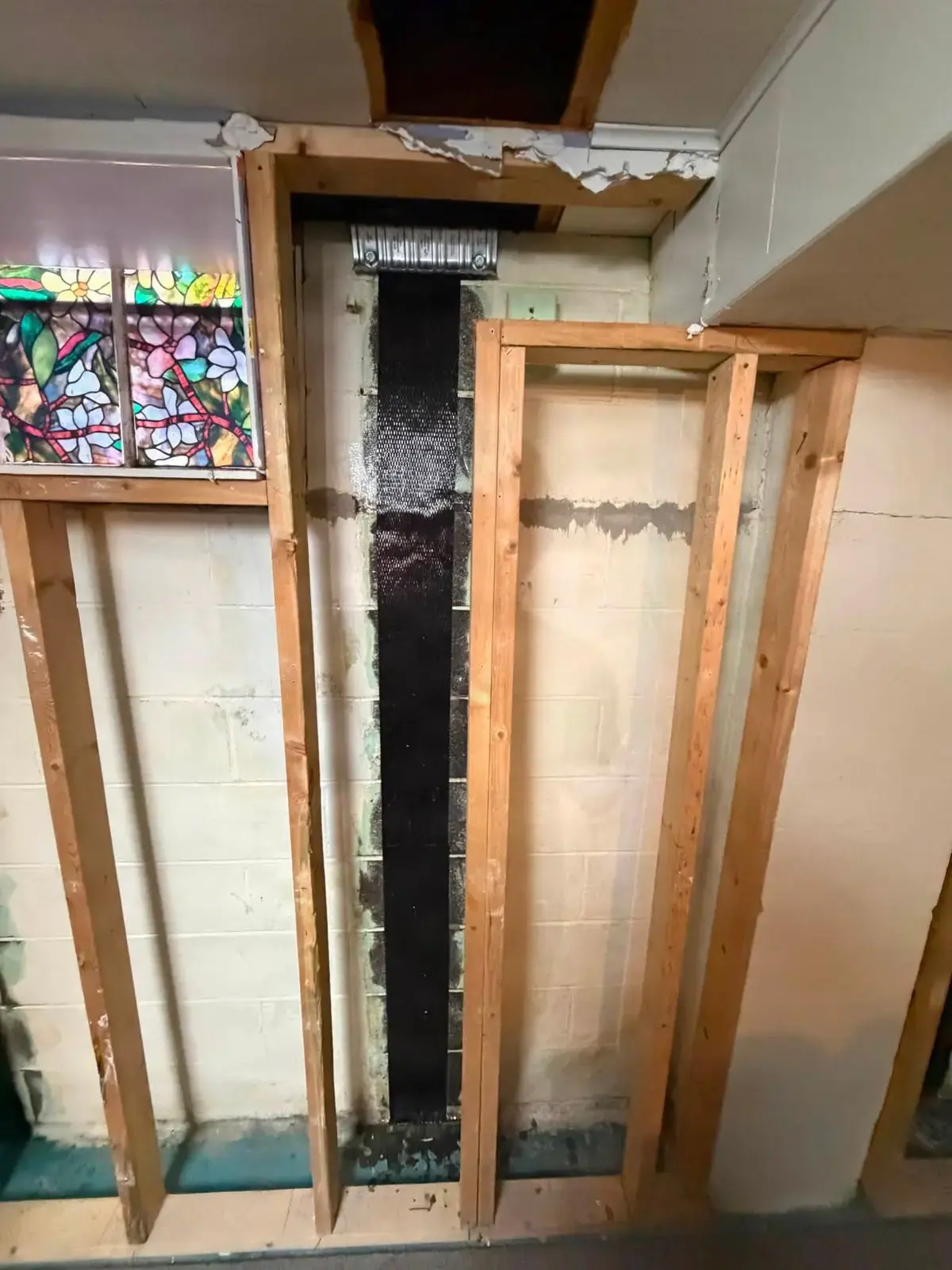
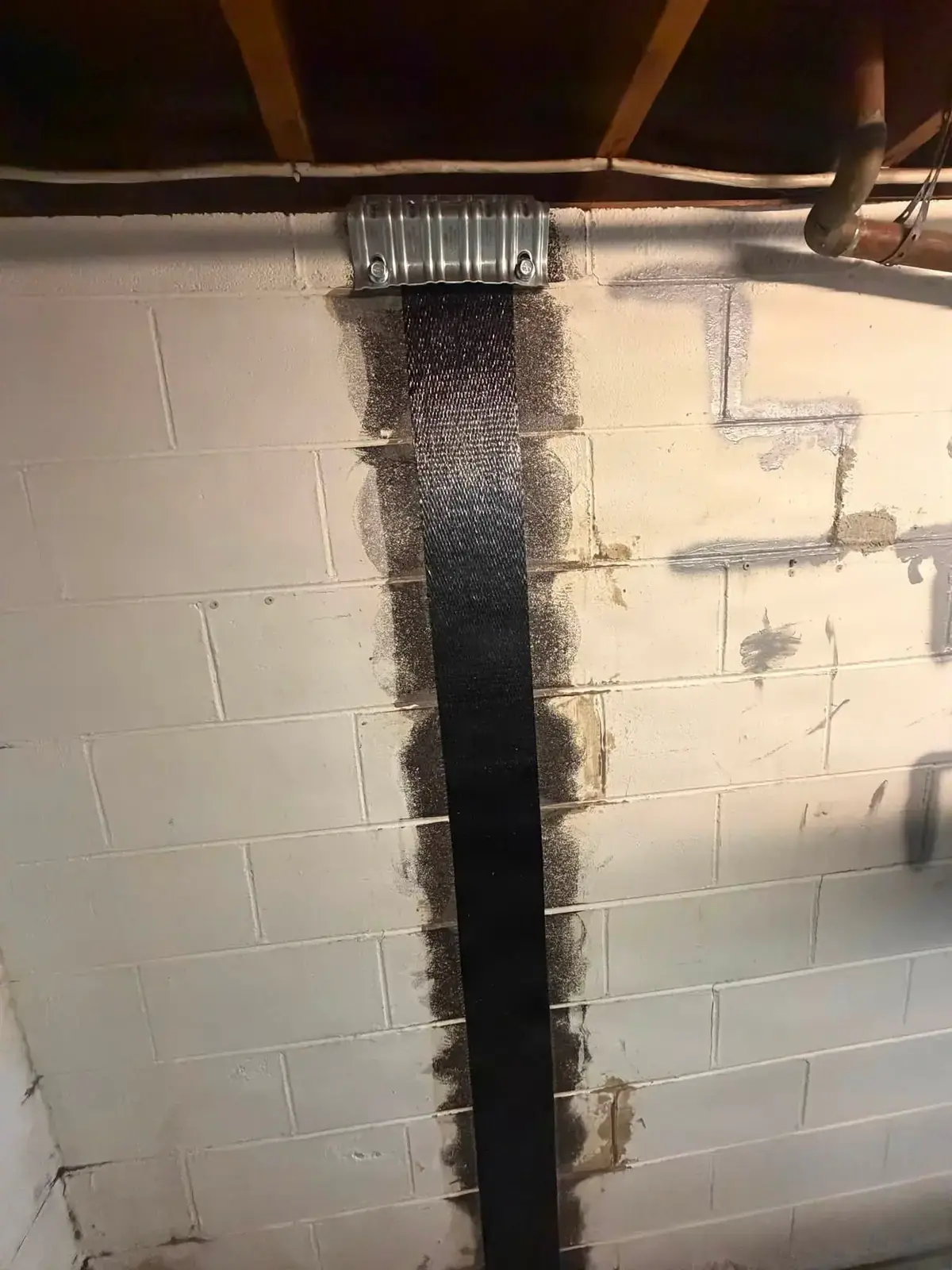
For bowing and cracked basement walls, we install carbon fiber wall straps. In our own words, they are one of the "least invasive solutions for stabilizing bowing or cracked basement walls", and "once properly installed, they help prevent further inward movement without the need for large excavation in many cases." The work happens from inside the basement, so the yard and the driveway stay as they are.
A strap is a band of carbon fiber that is very strong in tension. Bonded to the face of the wall from top to bottom and tied to the house frame at the top, it resists the wall bending any further inward. The job generally goes like this:
- Measure and lay out. We check how far the wall has moved and mark where each strap goes along its length.
- Prepare the wall. Paint, coatings and loose material come off at each strap line, and the surface is ground down to clean, sound masonry so the bond holds.
- Bond the strap. Epoxy goes on the wall, the strap is pressed into it from the top of the wall to the floor, and a second coat seals it in.
- Anchor top and bottom. The top of each strap is fastened to the sill plate or floor framing with a bracket, and the bottom is anchored at the base of the wall, so the wall can't pivot at either end.
- Finish. The straps sit nearly flat on the wall and can be painted over.
Our foundation repair work comes with transferable warranties, so they stay with the house if you sell it. Ask us about them when we give you the estimate.
“Very knowledgeable and respectful and super quality work.”
Giuseppe S., Google review
When Straps Aren't the Right Fix
Straps are made for walls that have started to bow, not for every wall. A wall that has pushed far in, has slid at its base, or has blocks breaking out of it may need steel beams, wall anchors, or excavation and a rebuild of that section. Major movement is a question for a structural engineer, and we'll tell you plainly when we think your wall needs one.
Undermined ground is the other case. Fayette County sits on the Pittsburgh coal seam, and about 31.7% of the county's area lies in PA DEP's "Underground Mining Area" on its Mine Subsidence Insurance risk map, including all of Uniontown. Pressure from wet soil builds slowly. A collapse in an old mine is sudden: new cracks that open over days or weeks, doors that stick all at once, a floor that drops. If that happens in an undermined area, call DEP's mine subsidence program first. We repair cracks and walls; we don't diagnose mine subsidence. DEP's own words on the coverage: "Mine subsidence insurance covers losses from earth movement and damage from the collapse of underground coal and clay mines in Pennsylvania", and "homeowner's insurance usually does not include it."
Repairing the Wall and the Water Behind It
Straps hold a wall. They don't change the wet soil that pushed it in, so a good foundation repair also looks at where the water comes from. Pennsylvania's building code requires that "Lots shall be graded to drain surface water away from foundation walls. The grade shall fall not fewer than 6 inches (152 mm) within the first 10 feet." On many older lots the ground has settled toward the house, and the gutters empty right at the wall that's bowing.
Depending on what we find, the rest of the job may include:
- Gutter lines and downspout extensions that carry roof water away from the wall, part of our drainage systems work.
- Interior or exterior drains that relieve the water pressure at the footing, with a sump pump where the water needs somewhere to go. Our basement waterproofing page explains the options.
- Crack repair where the wall has been leaking through.
- Support beams where the floor above has sagged along with the wall, covered on our crawl space repair and support beams page.
Not every bowed wall needs all of it. We'll show you what we found, what we'd do first and why, and you decide. Call (724) 912-8151 or send us a message through the contact page for a free inspection.
Is Your Basement Wall Starting to Bow?
Call (724) 912-8151 for a free estimate.
Questions We Hear a Lot

-
Look for a horizontal crack along the wall, stair-step cracks through the mortar of a block wall, or a wall that leans in at the top. Hold a level or a plumb line against the wall at its worst point. If you're not sure what you're looking at, the inspection is free: call (724) 912-8151.
-
On a wall that has started to bow, yes. The straps are bonded to the inside face of the wall and anchored top and bottom, and once properly installed they help prevent further inward movement, in many cases without large excavation. A wall that has moved a long way or slid at its base needs a structural engineer's look and a different repair.
-
Often, yes. Carbon fiber straps go on from inside the basement, so the yard stays as it is. Digging out is needed when the wall has to be straightened or rebuilt, or when the outside of the wall needs new drainage and waterproofing anyway.
-
Usually, yes. The soil pressure that pushed the wall in comes back every wet season and every hard freeze, so a bow tends to grow. Mark the ends of the crack with the date and check them after the next wet season, or have us measure the wall at a free inspection.
-
Yes. Our foundation repair work comes with transferable warranties, so they stay with the house if you sell it. Ask us about them when we give you your estimate.
-
Yes. Inspections and estimates are free. Call (724) 912-8151 or use the contact form, and we'll come look at the problem and tell you what we'd do.
-
We're based in Hopwood, PA, and serve Fayette County and the surrounding areas of Southwestern Pennsylvania, including Uniontown, Connellsville and Mount Pleasant. Call (724) 912-8151 to check your location.
-
- Service Area Fayette County, PA &
surrounding areas - Working Hours Open 24 hours7 days a week
-


